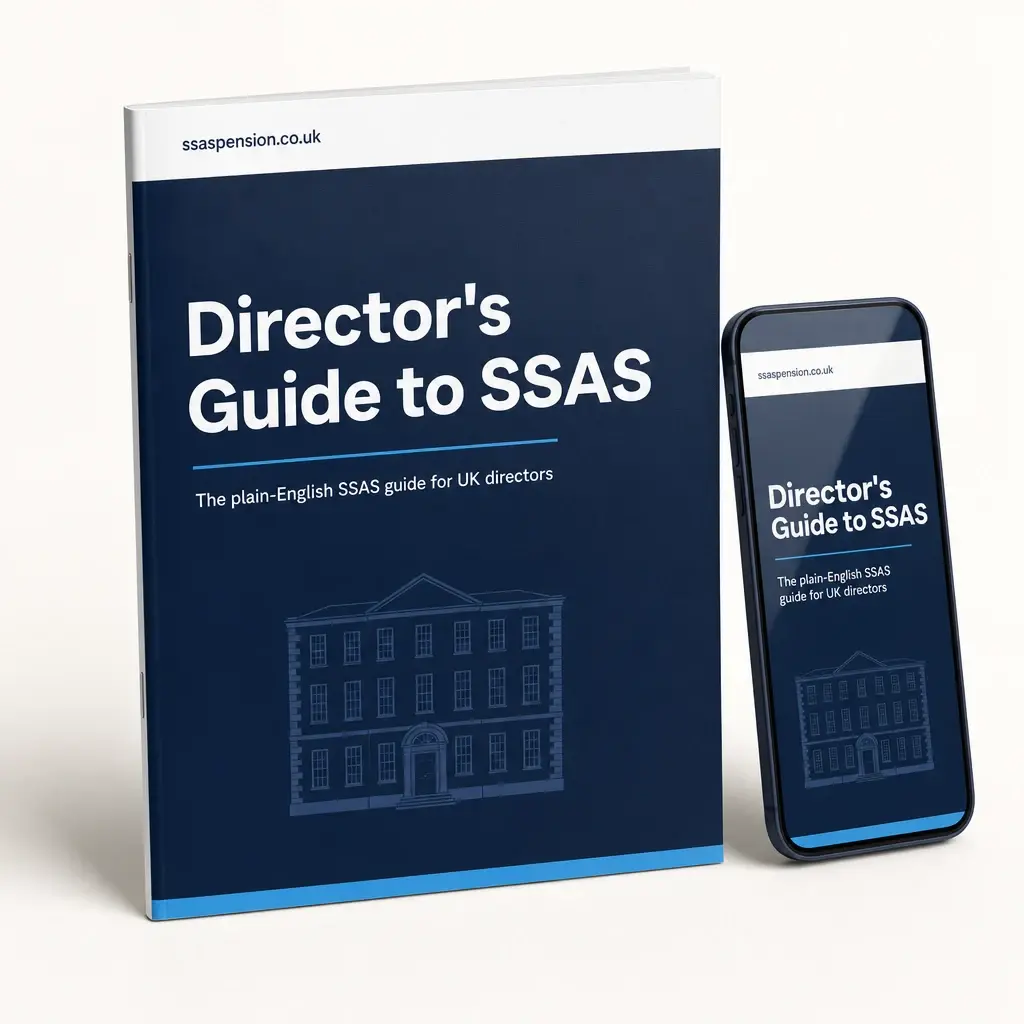
About this guide
A Small Self-Administered Scheme (SSAS) is a company pension established by a limited company for its directors, giving members direct control over how the fund is invested. This guide is for UK company directors who want an honest, comprehensive explanation of how a SSAS works, what it can be used for, and whether the structure suits their situation. After reading it, you will understand the key features, the tax advantages, and what the setup process involves — with enough detail to have a fully informed conversation with a specialist.
What you'll learn in the Complete SSAS Director's Guide
- Chapter 1 — What a SSAS actually is. The trust structure explained in plain English: how a SSAS differs from a personal pension or SIPP, how the occupational scheme framework works, and why directors act as trustees of their own pension fund.
- Chapter 2 — How contributions work. Employer contributions, personal contributions, and transfers — how each is made, how tax relief is applied, and how the annual allowance of £60,000 (2025/26) governs the total. Includes a worked section on carry-forward.
- Chapter 3 — The key benefits in detail. Corporation Tax relief on employer contributions (19–25%), tax-free growth inside the wrapper, the loanback facility, commercial property investment, and Inheritance Tax treatment under current rules and the proposed April 2027 changes.
- Chapter 4 — SSAS vs SIPP. A side-by-side comparison covering the loanback (SSAS only), multi-member pooling, minimum viable fund size, administrative cost, and which structure works for which director profile.
- Chapter 5 — Permitted and prohibited investments. What a SSAS can invest in — commercial property, listed equities, unquoted shares, loans — and what is absolutely prohibited: residential property, tangible moveable property, and loans to individual members.
- Chapter 6 — Contribution strategies. Three approaches directors use: the employer contribution strategy, salary sacrifice, and transfer consolidation — with the pros and cons of each.
- Chapter 7 — Taking benefits. When you can access your SSAS (minimum pension access age), the Pension Commencement Lump Sum (tax-free cash up to £268,275), and the drawdown options available.
- Chapter 8 — Setting up a SSAS. The eight-stage setup process from eligibility confirmation through HMRC registration to first investment, with a realistic timeline of 8–12 weeks.
- Chapter 9 — HMRC compliance. What a Scheme Sanction Charge is, how to avoid it, and why choosing an experienced scheme administrator matters.
This guide is written for you if…
- You are a director of a UK limited company and want to understand whether a SSAS could reduce your Corporation Tax bill while building your retirement fund
- You have heard about the SSAS loanback or commercial property strategies and want to understand exactly how they work before talking to anyone
- You are considering consolidating multiple old pensions into a single controlled structure
- You have a company with taxable profits of £100,000 or more and want to know whether a SSAS is appropriate at your stage
- You are early in the process — perhaps you've just set up your company, or you've been operating for years with no pension at all — and want a reliable starting point
This guide is not appropriate for sole traders (a sponsoring limited company is required), for directors whose company has minimal profitability, or for individuals seeking regulated financial advice. It is educational.
A note from the guide itself
“A SSAS works best when your company has meaningful profitability — typically £100,000+ in taxable profits — and when you have a horizon of at least several years before retirement.”
“The Lifetime Allowance was abolished in April 2024. There is no longer a cap on the total amount you can accumulate in pension savings, though there are still limits on the amount you can take as a tax-free lump sum.”
About this guide
Written by SSAS practitioners administering schemes for UK company directors. Published by Holtram TLPI Ltd, HMRC Scheme Administrator.
Questions about this guide
Is this guide really free?
Yes. There is no payment required. You provide your email address; we send you the guide and follow it up with a short email series on SSAS fundamentals. You can unsubscribe at any time.
What happens after I download?
You will receive an email within a few minutes containing your download link. Over the following weeks, you will receive a short series of educational emails on SSAS topics — covering the loanback, property strategies, tax planning, and the April 2027 IHT changes. We may follow up with a short educational email series.
Will you sell my data?
No. Your details are held by Holtram TLPI Ltd and used only for the purposes described above. We do not sell or share personal data with third parties for marketing purposes. Full details are in our Privacy Policy.
Who is Holtram TLPI Ltd?
TLPI are SSAS practitioners who have administered schemes for UK company directors. They are registered with HMRC as a pension scheme administrator. ssaspension.co.uk is the educational information resource published by TLPI.
Do I need a certain pension fund size to benefit from a SSAS?
A SSAS is most cost-effective once the fund reaches approximately £75,000–£100,000. Below that level, the professional administration fees represent a larger drag on returns. The guide covers this in detail, including the scenarios where a SIPP may be more appropriate.