Annual allowance and carry-forward
How much can you contribute to a SSAS each year? What happens if you have unused allowance from previous years? And what are the consequences if you go over the limit? These are among the most common questions UK directors ask when exploring SSAS pensions — and the answers have changed significantly in recent years.
The SSAS Annual Allowance for 2026/27 is £60,000 per member, per tax year — covering employer contributions, personal contributions, and HMRC tax relief across all pension arrangements (Finance Act 2004, s.228). Members who have not used their full allowance in the previous three tax years can carry unused amounts forward, potentially contributing up to £240,000 in a single year. If a member accesses pension savings flexibly, the Money Purchase Annual Allowance of £10,000 applies instead. The Lifetime Allowance was abolished from 6 April 2024.
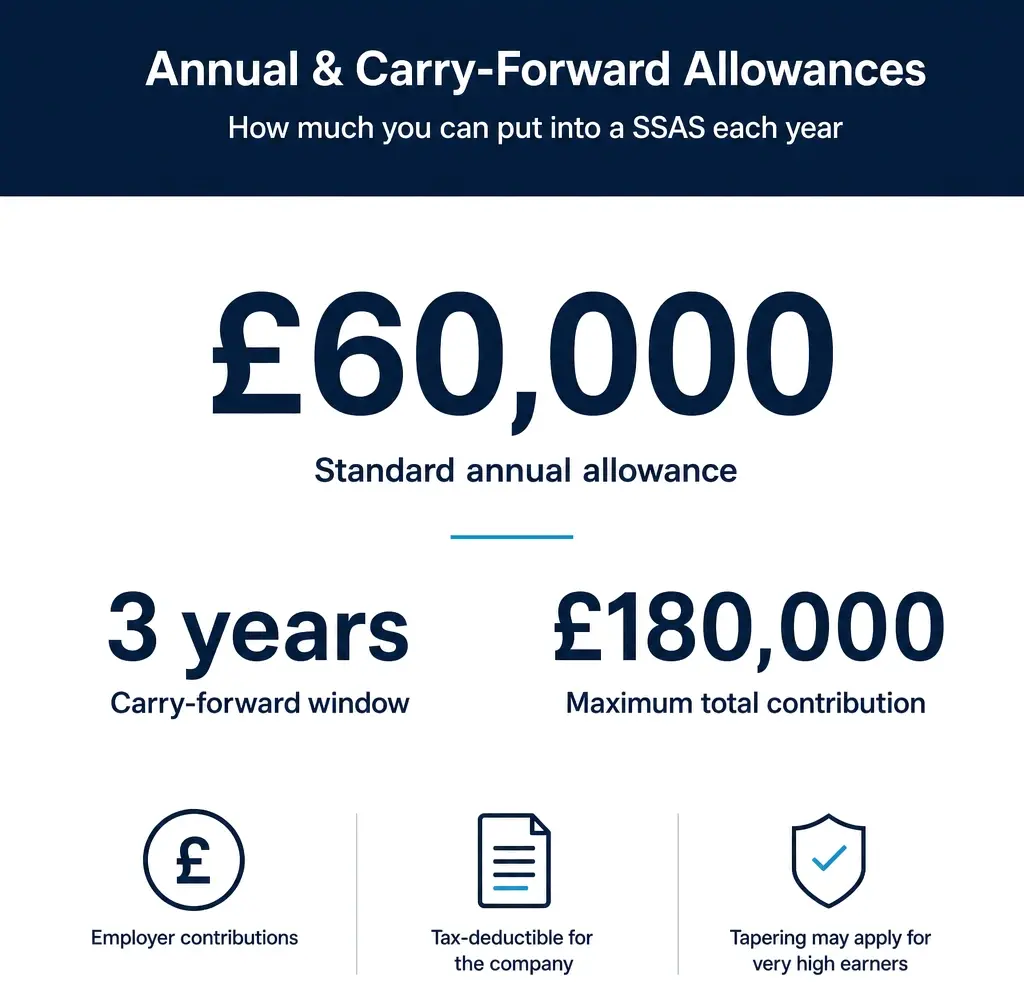
This guide covers the contribution rules for the 2026/27 tax year, including the Annual Allowance, carry forward, the Money Purchase Annual Allowance, and the abolition of the Lifetime Allowance.
The Annual Allowance: £60,000 in 2026/27
The Annual Allowance is the total amount that can be contributed to your pension arrangements — across all registered pension schemes you belong to — in a single tax year without triggering a tax charge. For 2026/27, the Annual Allowance is £60,000.
This £60,000 covers the combined total of:
- Employer contributions (paid by your company into the SSAS)
- Your own personal contributions (if you also make member contributions)
- Any contributions to other pension arrangements you hold, such as a legacy workplace pension
For most SSAS members who are company directors, the majority — or all — of their pension contributions will come from the sponsoring employer rather than from personal post-tax income. This is one of the structural advantages of a SSAS: the company funds the pension as a business expense, within HMRC rules.
Employer Contributions vs Personal Contributions
Employer contributions
When your company — the sponsoring employer — contributes to your SSAS, those contributions are a deductible business expense for Corporation Tax purposes, within HMRC rules. There is no upper limit on how much an employer can technically contribute in a single year, but contributions above the member's Annual Allowance will trigger an Annual Allowance charge (described below). HMRC also requires that employer contributions be "wholly and exclusively" for the purposes of the business — in practice, pension contributions for working directors routinely satisfy this test.
Personal (member) contributions
You can also contribute personally to your SSAS. Personal contributions attract Income Tax relief — basic rate tax relief is added automatically, and higher or additional rate taxpayers can claim further relief through their self-assessment tax return. However, personal contributions are capped at your relevant UK earnings for the year (your salary from the company, broadly speaking). If your salary is low, your personal contribution capacity may be lower than the £60,000 Annual Allowance.
For directors who pay themselves a modest salary and take most of their income as dividends, this matters: dividends do not count as relevant UK earnings for pension contribution purposes. This is why most SSAS directors prefer to use employer contributions rather than personal contributions — there is no earnings cap on employer contributions.
Carry Forward: Using Unused Allowances from Previous Years
If you have not used your full Annual Allowance in any of the three previous tax years, you may be able to carry those unused allowances forward into the current year. This can significantly increase the amount you can contribute in a single year.
The carry forward rules work as follows:
- You can carry forward unused Annual Allowance from the previous three tax years
- You must have been a member of a registered pension scheme in each year you wish to carry forward from (membership of any scheme counts — including a workplace pension from a previous employer)
- You must use the current year's full allowance first before drawing on carried-forward amounts
- Carried-forward allowances are used in chronological order — oldest first
Illustrative Example
Carry Forward in Practice
A director sets up a new SSAS in 2026/27. They want to understand how much they could potentially contribute in their first year, making use of unused allowances from the previous three tax years (the carry-forward window for 2026/27).
2023/24: Annual allowance was £60,000. No pension contributions made. Unused allowance: £60,000.
2024/25: Annual allowance was £60,000. No pension contributions made. Unused allowance: £60,000.
2025/26: Annual allowance was £60,000. No pension contributions made. Unused allowance: £60,000.
2026/27: Current allowance is £60,000. Total available: £60,000 + £60,000 + £60,000 + £60,000 = £240,000.
If the company makes a contribution of up to £240,000 in 2026/27, no Annual Allowance charge would apply — provided the director was a member of a registered pension scheme throughout those prior years. This example is illustrative; individual circumstances will vary.
Important: Carry forward calculations can be complex, particularly if you have changed employers, held multiple pension schemes, or have any defined benefit pension entitlement. It is worth confirming carry forward calculations with your scheme administrator before making a large single-year contribution.
What Happens if You Exceed the Annual Allowance
If your total pension contributions — employer and personal, across all schemes — exceed your available Annual Allowance in a tax year, the excess is subject to an Annual Allowance charge. This is a tax charge levied on the individual member (not the employer), charged at the individual's marginal Income Tax rate.
For example, if a director has £60,000 of available Annual Allowance and the company contributes £80,000 in a single year, the £20,000 excess would be added to the individual's taxable income and taxed at their marginal rate — typically 40% or 45% for most directors in this position.
The charge effectively claws back the tax relief on the excess. This does not mean the excess contribution is returned; the money stays in the pension. But the tax advantage on that portion is neutralised.
HMRC allows a mechanism called "scheme pays" for large Annual Allowance charges — if the charge is at least £2,000 and the pension scheme is responsible for the excess, the scheme can pay the charge on your behalf in exchange for a reduction in your eventual pension benefits. For a SSAS, voluntary scheme pays is also available but requires trustee agreement.
The Money Purchase Annual Allowance (MPAA): £10,000
If you have already accessed your SSAS or another money purchase pension flexibly — for example, by taking income through flexi-access drawdown — the standard £60,000 Annual Allowance no longer applies to your money purchase pension contributions. Instead, you are subject to the Money Purchase Annual Allowance (MPAA), which is currently £10,000 per year.
The MPAA is designed to prevent individuals from recycling pension funds — taking money out in drawdown and immediately reinvesting it as a tax-relieved contribution. Once triggered, the MPAA applies permanently.
Actions that trigger the MPAA include:
- Taking income through flexi-access drawdown from any money purchase pension
- Receiving an uncrystallised funds pension lump sum (UFPLS)
- Purchasing a flexible (investment-linked) annuity where income can vary downwards
Taking your tax-free cash lump sum alone (without also taking income from drawdown) does not trigger the MPAA, provided the rest of the uncrystallised fund remains in drawdown but no drawdown income has been taken.
Critical Point: If you are still contributing to your SSAS — particularly through large employer contributions — triggering the MPAA could have serious consequences, limiting your annual contributions to just £10,000. Plan carefully before accessing pension funds flexibly if you intend to continue making significant contributions.
The Lifetime Allowance: Abolished from April 2024
Until April 2023, there was a limit on the total amount of pension savings you could build up in your lifetime before facing a tax charge — the Lifetime Allowance (LTA). In its final form, the LTA was £1,073,100.
The LTA has now been abolished. From 6 April 2024, there is no lifetime limit on the amount of pension wealth you can accumulate. This is a significant change for higher earners who were previously managing their SSAS contributions carefully to avoid the LTA charge.
However, the abolition of the LTA does not mean there are no limits on pension benefits. Instead, HMRC has introduced two new lump sum allowances:
| Allowance | Amount (2026/27) | What it covers |
|---|---|---|
| Lump Sum Allowance (LSA) | £268,275 | The maximum tax-free lump sums you can take during your lifetime (including tax-free cash on crystallisation) |
| Lump Sum and Death Benefit Allowance (LSDBA) | £1,073,100 | The total of tax-free lump sums (including death benefit lump sums) that can be paid from all your pension schemes combined |
For most directors, the practical effect is that the 25% tax-free cash entitlement is now capped at £268,275 — regardless of total fund size. Funds above this threshold that are drawn as lump sums will be subject to Income Tax at the individual's marginal rate. Pension income taken through drawdown remains subject to Income Tax in the usual way.
Contribution Rules in Practice: A Summary for Directors
| Rule | Detail (2026/27) |
|---|---|
| Annual allowance | £60,000 per individual across all pension arrangements |
| Employer contribution cap | None (but contributions above AA trigger an individual tax charge) |
| Personal contribution cap | The lower of £60,000 or 100% of relevant UK earnings |
| Carry forward | Up to 3 previous tax years of unused allowance; must be a scheme member in those years |
| MPAA (if drawdown taken) | £10,000 per year |
| Lifetime allowance | Abolished from 6 April 2024 |
| Tax-free cash maximum | £268,275 (Lump Sum Allowance) regardless of fund size |
| Annual allowance charge rate | Individual's marginal Income Tax rate on the excess |
Frequently Asked Questions
What is the SSAS Annual Allowance for 2026/27?
The standard Annual Allowance is £60,000 per member, per tax year. This applies to the total of all employer contributions, member personal contributions, and HMRC tax relief into the scheme (Finance Act 2004, s.228, as amended by Finance (No. 2) Act 2023). The allowance is per individual, not per scheme — it covers all your registered pensions combined.
Can I carry forward unused SSAS Annual Allowance?
Yes. You can carry forward unused Annual Allowance from the previous three tax years, provided you were a member of a registered pension scheme in each of those years. With full carry forward, a director could potentially contribute up to £240,000 in a single tax year (current year £60k + three prior years £60k each), subject to the company being able to support the contribution under the wholly-and-exclusively rule.
What is the Tapered Annual Allowance for SSAS?
If your adjusted income exceeds £260,000 in a tax year, your Annual Allowance is tapered. For every £2 of income over £260,000, the allowance reduces by £1, down to a floor of £10,000 (for adjusted income of £360,000 or more). The taper is calculated per tax year and depends on both threshold income and adjusted income tests.
Can my company contribute more to my SSAS than I earn in salary?
Yes — employer contributions are not capped by your salary. Personal contributions are limited to your relevant UK earnings (typically salary, not dividends), but employer contributions are limited only by the Annual Allowance and the company’s ability to satisfy HMRC’s wholly-and-exclusively test. This is why most director-shareholder SSAS contributions come from the company, not from the director personally.
Are SSAS contributions tax-deductible for my company?
Yes. Employer contributions to a SSAS are normally deductible against Corporation Tax in the accounting period they are paid, provided they meet HMRC’s wholly-and-exclusively test — the contribution must be made for genuine business purposes, not pure tax avoidance. A company paying Corporation Tax at 25% saves £15,000 of tax on a £60,000 SSAS contribution.
Do I get personal Income Tax relief on SSAS contributions?
Personal contributions get Income Tax relief at your marginal rate. Basic rate relief (20%) is added at source by the SSAS administrator; higher and additional rate relief is claimed via Self Assessment. Employer contributions don’t generate personal tax relief because the company has already received Corporation Tax deduction — they go into the scheme gross.
Is there a lifetime limit on SSAS contributions?
The Lifetime Allowance was abolished in April 2024 and replaced with the Lump Sum Allowance (£268,275) and the Lump Sum and Death Benefit Allowance (£1,073,100). These limit the tax-free lump sums you can take, not the total fund value or the total contributions you can make over your lifetime. There is no longer a cap on how large your SSAS pot can grow.
Can my SSAS receive contributions from more than one company?
Yes, if you are a member or director of more than one limited company. Each sponsoring employer can make contributions, subject to your overall Annual Allowance across all schemes. The contributions need to be made on a wholly-and-exclusively basis from each contributing company — the contribution amount must be defensible as remuneration for services rendered to that specific company.
Key Point: The £60,000 Annual Allowance applies per individual member of the SSAS. If your SSAS has three director members, the scheme as a whole could potentially receive up to £180,000 in combined contributions — £60,000 per person — subject to each individual staying within their own allowance.
Disclaimer: This article is for educational purposes only and does not constitute financial, legal, or tax advice. SSAS Pension (ssaspension.co.uk) is a trading style of Holtram TLPI Ltd, an HMRC-registered Scheme Administrator. Holtram TLPI Ltd is not authorised by the Financial Conduct Authority. Pension and tax rules are subject to change and depend on individual circumstances. Always consult a qualified financial adviser before making pension decisions.