The short answer: No
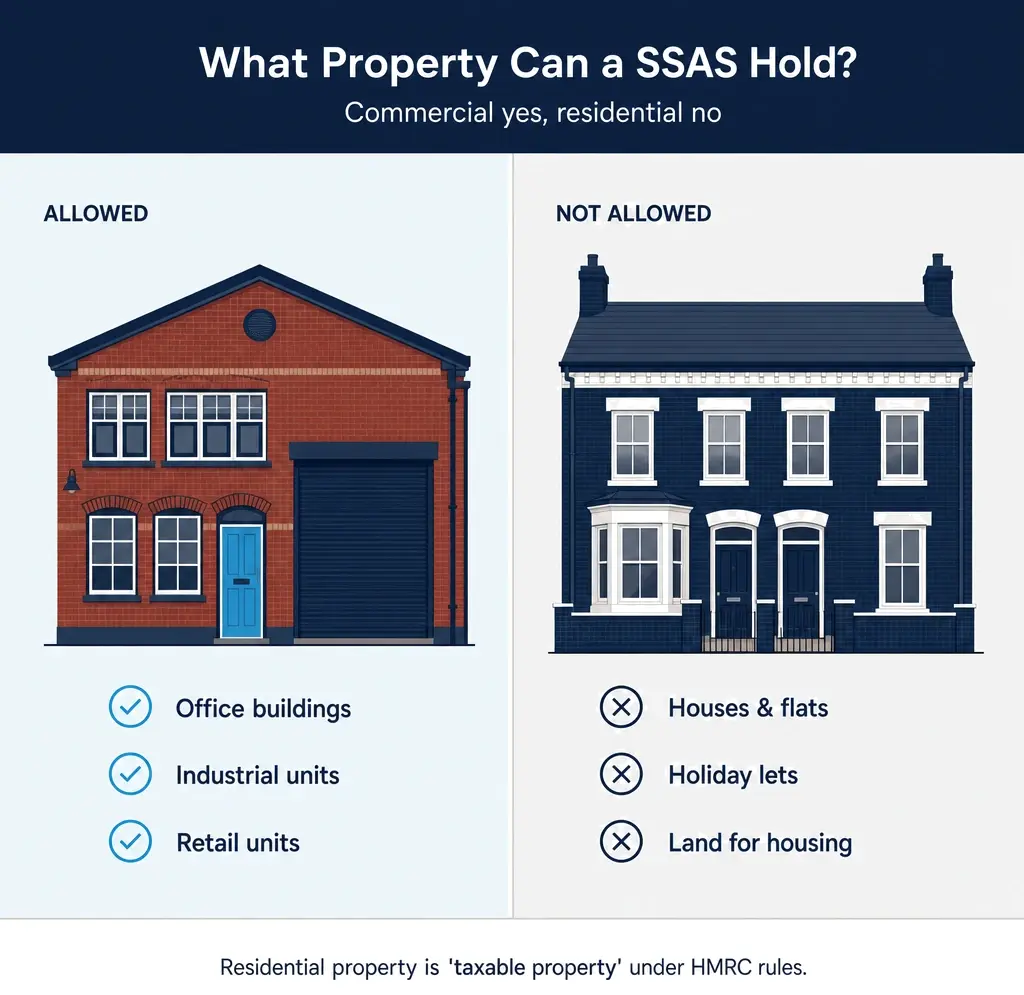
A SSAS cannot invest directly in residential property. HMRC classifies residential property as "taxable property," and holding it within a pension scheme triggers substantial tax charges. This prohibition applies to all registered pension schemes — not just SSAS — and there are no exceptions for buy-to-let or holiday lets.
Why a SSAS can't hold residential property
This is one of the most frequently asked questions about SSAS investment, often from directors who already own buy-to-let portfolios and wonder whether they can shelter those assets within their pension. The answer is clear: HMRC prohibits it, and the penalties for breaching the rules are severe.
What Counts as Residential Property?
Under HMRC's pension scheme rules (Finance Act 2004, Schedule 29A), residential property is broadly defined as any property that is suitable for use as a dwelling. This includes:
- Houses and flats, whether or not currently occupied
- Buy-to-let residential properties
- Holiday lets (including short-term holiday rentals such as Airbnb-type properties)
- Houses of multiple occupation (HMOs)
- Student accommodation
- Residential development land — land that has outline or full planning consent for residential development
- A property used partly as a home and partly for business purposes, where the residential element is significant
The test is whether the property is "suitable for use as a dwelling" — not whether it is currently used as one. A vacant property that could be lived in still falls within the prohibition.
Land with residential planning consent: It is not just built residential property that is prohibited. If a SSAS holds land and subsequently receives planning permission for residential development on that land, the land may become taxable property at that point. Trustees should take advice before pursuing residential planning consent on land held within the scheme.
The Taxable Property Rules and Their Origin
The "taxable property" rules were introduced in the Finance Act 2004 as part of the "A-Day" pension simplification reforms that came into effect on 6 April 2006. Before these reforms, some pension schemes had accumulated residential property, fine art, and other tangible assets. HMRC determined that using tax-advantaged pension wrappers to hold these personal-benefit assets was inconsistent with the purpose of pension tax relief, and the taxable property category was created to eliminate this practice.
The category of taxable property includes two sub-categories:
- Residential property: As described above — any property suitable for use as a dwelling
- Tangible moveable property: Physical assets such as fine art, wine, jewellery, vintage cars, and antiques — also prohibited in pension schemes
Penalties for Holding Taxable Property: The Scheme Sanction Charge
If a SSAS holds taxable property (including residential property), HMRC can levy a scheme sanction charge. This is a significant tax charge designed as a deterrent, not just a technical penalty.
| Illustrative penalty calculation — residential property in a SSAS | ||
|---|---|---|
| Residential property value in scheme | £300,000 | |
| Scheme sanction charge rate (maximum) | 40% | |
| Potential tax charge | £120,000 | |
| Plus unauthorised payments charge on member (PTM135200) | 40% | |
| Plus unauthorised payments surcharge (if payment exceeds 25% of fund value, PTM135300) | 15% | |
The scheme sanction charge can be up to 40% of the value of the taxable property investment. Additionally, if the acquisition or holding is treated as an unauthorised payment (which HMRC may determine in cases of deliberate non-compliance), an additional 15% unauthorised payments surcharge applies to the member when the unauthorised payment exceeds 25% of fund value (PTM135300). The member also faces a 40% unauthorised payments charge (PTM135200), and the scheme faces a scheme sanction charge of up to 40% — reduced to 15% net when the member pays the unauthorised payments charge (PTM135400). Maximum combined exposure: 70%. In the most serious cases, the combined charges can exceed the value of the original investment.
HMRC does not have to prove that the trustees intended to create a prohibited investment. If taxable property is held within the scheme — even if the trustees were unaware the rules applied — the charge can still arise.
The One Exception: Commercial Property with Incidental Residential Use
HMRC's rules do include a narrow exception for commercial property that contains an element of residential accommodation, provided that element is genuinely incidental to the commercial use. The legislation refers to this as "incidental residential use."
The clearest example is a pub or hotel that includes a flat for the resident landlord. If the primary use of the building is clearly commercial (the pub or hotel business) and the residential element is ancillary to that use, the property may be treated as commercial property for pension purposes, and the entire property can be held within the SSAS.
HMRC's tests for whether residential use is truly "incidental" are strict. The residential element must be genuinely subordinate to the commercial use — not merely a secondary element alongside a comparable commercial use. Mixed-use properties where the residential and commercial elements are roughly equal in size or value will not qualify. Speak to your SSAS scheme administrator before assuming that a mixed-use property qualifies as commercial for SSAS purposes.
A caretaker's flat: A commercial warehouse with a small self-contained flat used by an on-site caretaker is the type of arrangement most likely to qualify as incidental. The flat is clearly subordinate to the warehouse's commercial function, and its purpose is operational rather than residential investment.
Alternatives for Property Investors
If your interest in a SSAS is primarily driven by property investment, the prohibition on residential property does not eliminate the scheme's property investment potential. It simply redirects it towards commercial property and commercial development lending — areas where a SSAS has genuine advantages.
Commercial property purchase
A SSAS can purchase commercial property directly — offices, industrial units, retail premises, and commercial land. Any capital growth and rental income accumulate free of tax within HMRC's rules.
Development finance loans
The SSAS can lend money to property developers — including residential developers — as an unconnected third-party loan. The scheme earns commercial interest on the loan, all of which grows tax-free within the pension.
Property investment funds
Certain regulated property investment funds (REITs and commercial property funds) can be held within a SSAS as listed investments. These provide indirect exposure to property markets within a compliant structure.
Your own business premises
One of the most popular uses of a SSAS: purchasing the commercial premises your business currently rents. The business then pays market rent to the scheme — rent that is both a deductible business expense and tax-free pension income.
Summary
A SSAS cannot hold residential property — this is a clear and absolute HMRC rule with no general exceptions. The prohibition covers all forms of residential property, including buy-to-let, holiday lets, HMOs, and residential development land. Breaching the rule attracts a scheme sanction charge of up to 40% of the investment's value, with the potential for further surcharges. The narrow exception for genuinely incidental residential use within a primarily commercial property is limited and requires specialist advice. For directors interested in property investment through a SSAS, commercial property purchase and development lending provide the alternatives — within HMRC's permitted investment rules.
Disclaimer: This article is for educational purposes only and does not constitute financial or tax advice. HMRC's taxable property rules are complex, and the application of the incidental residential use exception is highly fact-specific. Speak to your SSAS scheme administrator before making any investment decision through a SSAS.