Can you have a family SSAS?
One of the features that makes a SSAS genuinely distinctive is the ability to include multiple family members as scheme members — all sharing the same pension structure, the same investment pool, and the same trustee framework. For family-run businesses, this creates a unified approach to pension planning across generations.
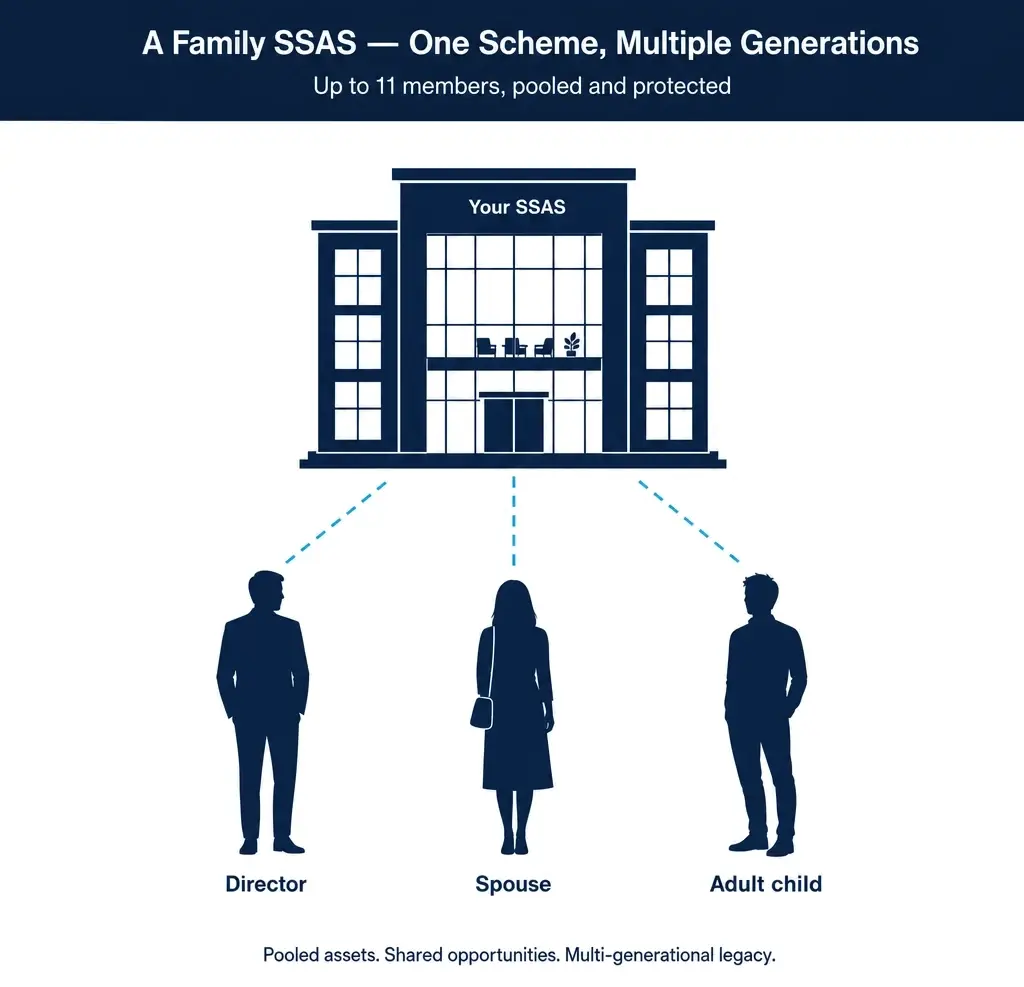
The Up to 11 Members Rule
A SSAS can have up to 11 members. This limit is set by HMRC's definition of a small self-administered scheme and is one of the defining characteristics that separates a SSAS from a SIPP or personal pension, both of which are individual arrangements.
All 11 membership slots can be used, though in practice most family SSAS schemes operate with between 2 and 6 members. The 11-member cap is per scheme — a business that grows beyond 11 eligible members would need to consider whether a larger occupational scheme structure is more appropriate.
Who Qualifies as a SSAS Member?
The eligibility requirement for SSAS membership is the source of most questions in family planning contexts. All members must be connected to the sponsoring employer — the company whose pension scheme this is. This connection can exist in two ways:
- Employees of the sponsoring employer: Including directors, salaried employees, and other staff on the payroll
- Connected persons: As defined in HMRC's pension scheme rules, typically including spouses, civil partners, and direct relatives who are also employees
The crucial point is that family membership is not automatic. Simply being related to the director who established the SSAS is not sufficient. The family member must also have a genuine employment connection to the sponsoring company.
Within HMRC rules: Each member's contributions must be commensurate with their employment status and earnings from the sponsoring employer. Pension contributions are tax-advantaged within HMRC rules — contributions unrelated to genuine employment can attract scrutiny.
Common Family Member Configurations
Here are the most common ways family members are included in a SSAS in practice:
Director / Founder
Primary member, typically scheme initiator
Spouse / Partner
If employed by the company
Adult Children
Must be employed by sponsoring employer
Co-Director
Fellow directors qualify as employees
Key Employees
Non-family senior staff
Adding a spouse or civil partner
A spouse or civil partner can join the SSAS provided they are genuinely employed by the sponsoring company. This is one of the most common configurations for owner-managed businesses where both partners work in the business. Employer contributions to the spouse's pension pot are a deductible business expense, and both partners' pension funds benefit from the same tax-free investment growth environment within HMRC rules.
Adding adult children
Adult children who work in the family business can be added as SSAS members. The employment must be genuine — meaning the child must be on the payroll, performing a real role, and earning a salary commensurate with their responsibilities. The employment relationship cannot be artificial purely to gain pension access. Where these conditions are met, adult children can begin building pension savings within the family SSAS from the point of joining the company.
Minimum age considerations
There is no statutory minimum age for SSAS membership, but HMRC pension rules require that benefits cannot normally be taken before age 57 (rising from 55 to 57 in April 2028). Very young members — for example, a 21-year-old who has just joined the family business — will be building pension savings over a very long time horizon, which has both advantages (long compounding period) and administrative implications for the scheme.
The Benefits of Pooling Family Pensions
When multiple family members join a SSAS, their individual pension contributions and transferred-in pensions pool into a single fund. This pooling has several practical benefits.
Larger investment capacity
Commercial property acquisition, in particular, benefits from scale. A single director with a £200,000 pension fund may struggle to purchase commercial property directly. Add a spouse with £150,000 and an adult child who transfers in £80,000, and the combined £430,000 fund could begin to make meaningful commercial property investments — potentially with borrowing taking total purchasing power higher still.
Shared investment infrastructure
The scheme has a single bank account, a single administration process, and a single set of trust documents. Rather than each family member maintaining separate SIPPs or personal pensions with different providers, all pension activity is consolidated into one structure with one professional administrator.
Combined employer contributions
The sponsoring employer can make contributions on behalf of all employed family members simultaneously. Each contribution reduces the company's taxable profit, within HMRC's Annual Allowance rules. For a family where multiple members are employed, the potential aggregate contribution could be substantial — potentially up to £60,000 per member per year for the 2025/26 tax year, subject to the individual's relevant UK earnings.
Succession Planning Through a Family SSAS
A family SSAS is a particularly powerful tool for multi-generational business succession planning. The scheme's structure creates several succession-friendly features that standard pension arrangements cannot replicate.
Death benefits outside the estate
SSAS pension funds held at death can be paid to nominated beneficiaries as lump sums or ongoing pension income. Under current rules, uncrystallised SSAS funds paid on death are outside the member's estate for Inheritance Tax purposes — though the government's proposed changes to include pension funds in estates from April 2027 mean this position may change for deaths on or after that date. Always take current advice on the IHT treatment of pension death benefits.
Pension continuation across generations
When a SSAS member dies, their accrued pension within the scheme can be passed to nominated beneficiaries who are already scheme members. A parent-and-child SSAS configuration means the child can potentially continue the pension structure rather than it unwinding at the parent's death. This can preserve the scheme's property holdings or other long-term investments without the disruption of forced sales.
Gradual transfer of trustee responsibility
As adult children become more senior in the family business and more experienced as SSAS trustees, investment decision-making can naturally transition towards the next generation. The founding director can step back from active management while remaining a trustee, giving successors genuine experience of running a pension trust before taking full control.
Control Through the Trustee Structure
In a SSAS, all members are typically trustees of the scheme. This means investment decisions require the collective agreement of the trustees. For a family scheme, this creates important dynamics:
- Collective decision-making: Major investment decisions require trustee consensus. This prevents any single member unilaterally directing scheme assets.
- Documentation of decisions: All trustee decisions must be formally recorded in writing. A professional SSAS administrator will maintain this record on the scheme's behalf.
- Fiduciary duty: Each trustee owes a duty to act in the best interests of all scheme members — not just themselves. In a family context, this means decisions that benefit one member at the expense of others require careful handling.
Important consideration: Family dynamics can be complex. The shared trustee structure means that disagreements between family members — whether business-related or personal — can affect the scheme's operation. This is a practical consideration that should be discussed openly before bringing multiple family members into a SSAS.
Practical Considerations
Employment documentation
Each family member added as a SSAS member should have a current employment contract with the sponsoring employer, a PAYE record, and evidence that their salary reflects their role. HMRC can challenge pension contributions that appear disproportionate to a member's salary or role. Good record-keeping is essential.
Contribution proportionality
While there is no rule requiring contributions to be equal across members, contributions must be justifiable in relation to each member's employment. Concentrating very large contributions into one member's pot while making nominal contributions to others may attract HMRC attention if the contributions appear structured primarily to benefit one individual.
Scheme rules and member interests
The SSAS Trust Deed will set out how the scheme operates, how benefits are calculated, and what happens if a member leaves the scheme or the sponsoring employer. Review the scheme rules carefully when adding new members, particularly younger family members whose circumstances may change significantly over the scheme's lifetime.
Annual allowance management
For the 2025/26 tax year, the Annual Allowance for pension contributions is £60,000 per individual (subject to the Tapered Annual Allowance for high earners). Where the company makes large contributions to multiple family members simultaneously, it is important to track each individual's position against their personal Annual Allowance to avoid tax charges.
Summary
A family SSAS is one of the most flexible and powerful structures available to owner-managed businesses for multi-generational pension planning. Including a spouse, adult children, or co-directors in the scheme pools pension capital, reduces administration, and creates a succession-ready framework that standard pension products simply cannot replicate. The prerequisite is genuine employment of all members by the sponsoring employer — a requirement that keeps the arrangement within HMRC's rules and ensures the scheme's integrity.
Disclaimer: This article is for educational purposes and does not constitute financial or tax advice. The eligibility and contribution rules for SSAS membership are complex. Always seek professional advice before adding family members to a SSAS.