How much can your SSAS lend back to your company?
One of the most powerful features of a Small Self-Administered Scheme is the loanback: the ability to lend SSAS money to the sponsoring employer. It's a feature SIPPs simply can't match — but HMRC sets five firm rules, and crossing any of them can trigger tax charges of up to 70% on the member. This guide covers the SSAS loanback rules in detail, walks through a worked £500,000 example, and explains exactly what happens if the rules are broken.
A SSAS loanback is a loan from a Small Self-Administered Scheme to its sponsoring employer. HMRC rules require the loan to not exceed 50% of net scheme assets, carry interest at no less than the HMRC prescribed rate (six-bank average base rate + 1%, rounded up to 0.25%), follow a fixed repayment schedule of no more than 5 years with at least equal annual repayments, and be fully documented. The loan must be secured. We work through the options with you. Breaches trigger unauthorised payment charges of up to 70%.
Last updated: June 2026 · 12 min read · UK 2026/27 tax year
What is a SSAS loanback?
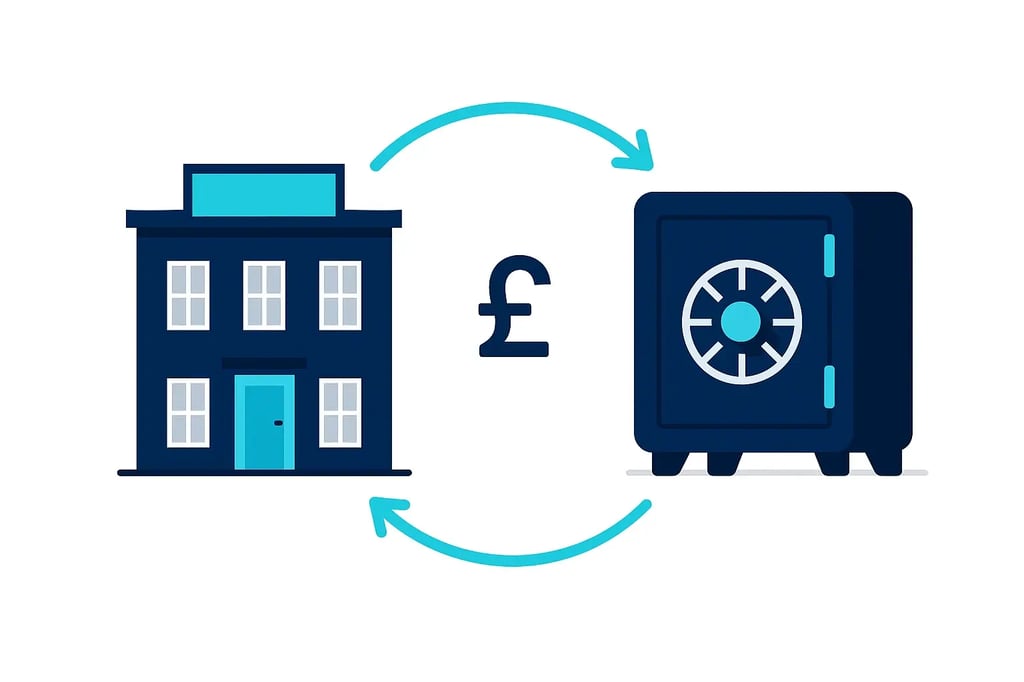
A SSAS loanback is, in plain terms, your pension scheme lending money to the company that established it. The SSAS holds the cash; the sponsoring employer borrows it; and the loan is repaid (with interest) back into the pension over a fixed term. The interest paid is corporation tax deductible for the company and grows tax-free in the pension — a structure that, when used correctly, can be considerably cheaper than commercial borrowing.
The loanback is unique to SSAS schemes. A SIPP (Self-Invested Personal Pension) cannot lend to a sponsoring employer because SIPPs are personal pensions, not occupational schemes — there is no employer in the SIPP structure to lend to. This is the single defining commercial difference between the two pension types for UK company directors, and the main reason loanback queries dominate informational search traffic on SSAS topics.
Loanbacks are not, however, a back door to taking money out of the pension. HMRC's Pensions Tax Manual (PTM123200) sets out a precise framework that determines what an authorised employer loan looks like, and any loan that fails the test is treated as an unauthorised payment — with charges that, in combination, can reach 70% of the loan value.
The 5 HMRC rules in detail
Rule 1: The 50% asset limit
The outstanding loan balance must not exceed 50% of net SSAS scheme assets at the point the loan is made. "Net scheme assets" means the gross market value of everything the scheme holds, less existing scheme liabilities. The test is applied at inception only — subsequent fluctuations in scheme value do not retrospectively trigger a breach. Multiple concurrent loanbacks are permitted provided the total outstanding never exceeds the 50% threshold.
Rule 2: Minimum interest rate
The minimum interest rate is the HMRC prescribed rate (six-bank average base rate + 1%, rounded up to 0.25%). There is no single published figure: the six banks' rates are checked on the day of drawdown. This is a floor, not a ceiling — trustees are free to charge a higher rate where the commercial position warrants it. The rate must be reviewed on each anniversary, and interest must actually be charged and received: a notional or rolled-up interest figure is not acceptable to HMRC.
Rule 3: Maximum 5-year term
The loan term must not exceed 5 years from the date of drawdown, with at least equal annual repayments of capital and interest. The instalments do not have to be exactly equal — HMRC accepts a level-repayment schedule using standard amortisation methodology — but each annual instalment must include both interest and a meaningful slice of principal. Interest-only loans are not permitted under the loanback rules.
Rule 4: Security
The loan must be secured. We work through the options with you.
Rule 5: Full documentation
The scheme administrator must hold, before drawdown, a written loan agreement and trustee resolutions authorising the loan. HMRC inspectors will request these in any scheme review — missing or backdated documentation will, in itself, jeopardise the loan's authorised status under PTM123200. Documentation discipline is the single most common failure point in HMRC SSAS loan rules compliance.
SSAS loanback calculator
Enter your scheme's net assets and proposed loan terms below. The calculator works out the annual repayment, total interest paid, and the full year-by-year amortisation, and flags any breach of the HMRC rules above. The default interest rate shown is illustrative only.
Compliant SSAS Loanback
- Loan amount ≤ 50% of net scheme assets at inception
- Interest at or above the HMRC prescribed rate (six-bank average base rate + 1%, rounded up to 0.25%)
- Maximum 5-year term with equal annual repayments
- The loan must be secured. We work through the options with you.
- Full documentation: loan agreement and trustee minutes
- Loan to sponsoring employer only
What Triggers an Unauthorised Payment
- Loan exceeds 50% of net scheme assets
- Interest rate below the HMRC prescribed rate
- Term over 5 years or interest-only repayments
- Missing or backdated loan documentation
- Loan to a connected party rather than the sponsoring employer
Worked example: a £500,000 SSAS loanback
Imagine a profitable UK manufacturing company — we'll call it Example Engineering Ltd. The directors' SSAS holds £1,000,000 in net scheme assets (mainly commercial property and listed equities). Example Engineering wants to fund a £500,000 CNC machine purchase, and a SSAS loanback is on the table.
Loan structure (compliance check)
- Amount: £500,000 — at the 50% limit on £1m net assets. ✓ Compliant with Rule 1.
- Security: The loan must be secured. We work through the options with you.
- Interest: 5.75% used for illustration only, not a current rate. The minimum is the HMRC prescribed rate (six-bank average base rate + 1%, rounded up to 0.25%), checked on the day of drawdown.
- Term: 5 years, equal annual repayments of £117,892. ✓ Compliant with Rule 3.
- Documentation: Loan agreement and trustee minutes. ✓ Compliant with Rule 5.
Year-by-year amortisation
| Year | Opening balance | Interest | Capital | Total payment | Closing balance |
|---|---|---|---|---|---|
| 1 | £500,000 | £28,750 | £89,142 | £117,892 | £410,858 |
| 2 | £410,858 | £23,624 | £94,268 | £117,892 | £316,590 |
| 3 | £316,590 | £18,204 | £99,688 | £117,892 | £216,902 |
| 4 | £216,902 | £12,472 | £105,420 | £117,892 | £111,482 |
| 5 | £111,482 | £6,410 | £111,482 | £117,892 | £0 |
Total interest paid back into the pension: ~£89,460 over 5 years. Compared to a typical bank loan at ~7.5%, the company saves around £8,000 in total interest cost — but more importantly, that interest accrues tax-free inside the SSAS rather than going to a third-party lender.
What if Example Engineering couldn't repay?
The trustees would be obliged to take action to recover principal plus accrued interest. Failure to do so is itself an unauthorised payment by the trustees, so HMRC's expectation is that this is not optional.
What happens if HMRC SSAS loan rules are breached?
If a loanback fails any of the five HMRC rules, the loan is treated as an unauthorised payment. The headline consequences (PTM135000):
- Unauthorised payments charge — 40% on the member receiving the benefit. Where the unauthorised payment exceeds 25% of the pension value over a 12-month period, an additional 15% surcharge applies.
- Scheme sanction charge — 15% to 40% on the scheme administrator. The exact rate depends on whether the unauthorised payments charge was paid by the member.
- De-registration risk for persistent or significant breaches. HMRC may withdraw the scheme's registered status, with consequent tax charges on the entire fund.
The combined exposure on a single failed loanback can therefore reach 70% of the loan value. On a £500,000 loan, that's a £350,000 tax bill — for what should have been routine company finance. Documentation discipline is not optional.
SSAS loanback vs other business borrowing
How does a properly structured SSAS loanback compare with alternative financing routes?
| Factor | SSAS Loanback | Bank Term Loan | Invoice Finance |
|---|---|---|---|
| Speed to drawdown | 4–6 weeks | 8–12 weeks | 2–4 weeks |
| Interest destination | Stays in your pension (tax-free growth) | Bank profit | Finance provider profit |
| Security required | The loan must be secured. We work through the options with you. | Variable; often debenture + PG | Receivables only |
| Maximum loan | 50% of net SSAS assets | Credit-dependent | % of debtor book |
Frequently Asked Questions
Can a SSAS loanback be used for any business purpose?
Yes. HMRC does not prescribe what the loan is used for — capital expenditure, working capital, property acquisition, growth investment, refinancing other debt — but the borrower must be the sponsoring employer, not a connected party.
How long does a SSAS loanback take to set up?
Typically 4–6 weeks: scheme valuation → loan agreement drafting → trustee resolution → drawdown. Faster than most commercial term loans.
Can the SSAS loan to a connected company rather than the sponsoring employer?
No — the loanback rules in PTM123200 specifically permit lending to the sponsoring employer. Loans to other connected parties fall under different and stricter rules and are usually treated as unauthorised payments.
What's the difference between a loanback and a third-party loan from a SSAS?
A loanback is to the sponsoring employer (specifically permitted under PTM123200). A third-party loan is to an unconnected business and is treated as an investment — fewer constraints, no 50% cap, but commercial-rate interest negotiated at arm's length.
Does a SSAS loanback need to be secured?
The loan must be secured. We work through the options with you.
What happens if the company can't repay?
Trustees must take action to recover principal plus interest. Failure to do so is itself an unauthorised payment by the trustees.
Does the loanback interest reduce the company's corporation tax?
Yes — interest paid by the company to the SSAS is treated as a normal business interest expense, deductible against corporation tax. The interest received by the SSAS grows tax-free inside the scheme.
Can multiple loanbacks run concurrently?
Yes, provided the total outstanding loanback balance never exceeds 50% of net scheme assets. Each individual loanback must independently satisfy all five HMRC rules.
What counts as "net scheme assets" for the 50% test?
Gross scheme assets at market value, less existing scheme liabilities (other outstanding loans, unpaid taxes, accrued expenses). Tested at loan inception only — subsequent asset value fluctuations do not retrospectively trigger a breach.
Is a SSAS loanback considered "borrowing" by the SSAS itself?
No — the SSAS is lending, not borrowing. SSAS schemes can separately borrow (also up to 50% of net assets), and that limit is independent of any outstanding loanbacks the scheme has made.
Sources & references
- HMRC Pensions Tax Manual: PTM123200 — Investments: loans: loans to sponsoring employers
- HMRC Pensions Tax Manual: PTM135000 — Unauthorised payments charge
- The Pensions Regulator: Trustee Toolkit
Disclaimer: This article is for educational purposes only and does not constitute financial, legal, or tax advice. SSAS Pension (ssaspension.co.uk) is a trading style of Holtram TLPI Ltd, an HMRC-registered Scheme Administrator. Holtram TLPI Ltd is not authorised by the Financial Conduct Authority. Pension and tax rules are subject to change and depend on individual circumstances. Always consult a qualified financial adviser before making pension decisions.